Noah Vogel · 19 September 2026
Tracing the Development of Flexible Verification Frameworks in Response to Evolving Digital Landscapes
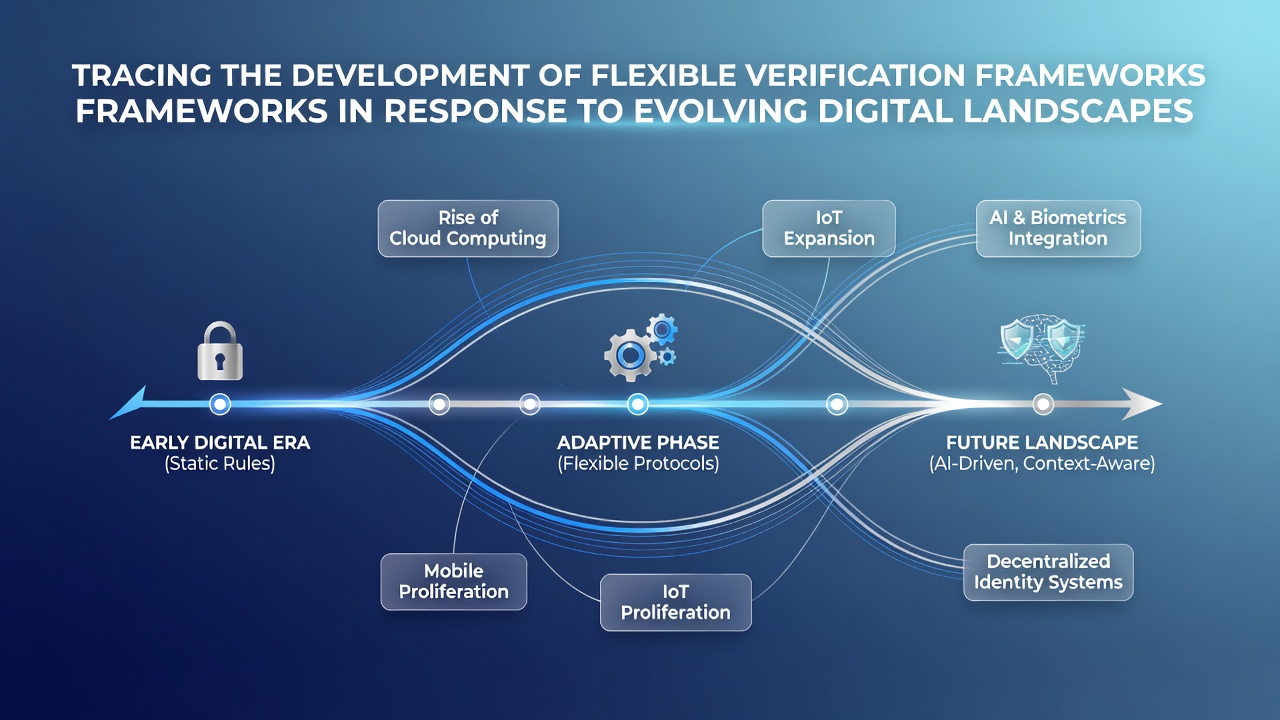
Digital verification systems have shifted from static password checks to layered, adaptive processes that adjust in real time to user behavior and threat patterns, and this progression reflects broader changes in how organizations manage identity across connected platforms. Early frameworks relied on fixed rules that processed login attempts through simple database lookups, yet those approaches proved insufficient once mobile devices and cloud services introduced new variables such as location shifts and device fingerprints.
Early Foundations and Initial Adaptations
During the 2000s verification relied heavily on knowledge-based authentication, while regulatory pressure from data protection laws began to require stronger audit trails. Researchers documented how organizations started embedding multi-factor elements, combining something a user knows with something they possess, and this combination reduced unauthorized access rates according to reports from the National Institute of Standards and Technology. Flexible elements entered the picture when systems began logging contextual signals such as IP reputation and time-of-day patterns, allowing rules to adjust without manual intervention each time a new device appeared.
Regulatory Drivers and Technical Responses
Government initiatives shaped the next phase, and the European Commission outlined requirements under the eIDAS regulation that pushed member states toward interoperable electronic identification schemes. Those standards encouraged verification frameworks to incorporate modular components so that updates to one layer, such as biometric matching, would not require a full system overhaul. Data from industry surveys indicate that by 2018 adoption of risk-based authentication had risen sharply among financial and healthcare providers because static methods no longer met compliance thresholds for transaction monitoring.
Cloud infrastructure added another layer of complexity because verification requests now crossed multiple jurisdictions in a single session, and frameworks responded by distributing decision engines across edge nodes. Observers note that this distribution allowed latency-sensitive checks to occur closer to the user while centralized policy engines retained oversight of overall risk scores.
Integration of Machine Learning and Real-Time Adjustment
Machine learning models entered verification pipelines around 2015, and these models analyzed sequences of events rather than isolated data points, which improved detection of credential stuffing campaigns. Studies published by academic institutions showed that anomaly detection reduced false positives by up to 40 percent compared with rule-only systems, and the improvement freed analysts to focus on higher-severity alerts. Flexible frameworks therefore began exposing configuration APIs so that model retraining cycles could be triggered automatically when new attack signatures emerged.
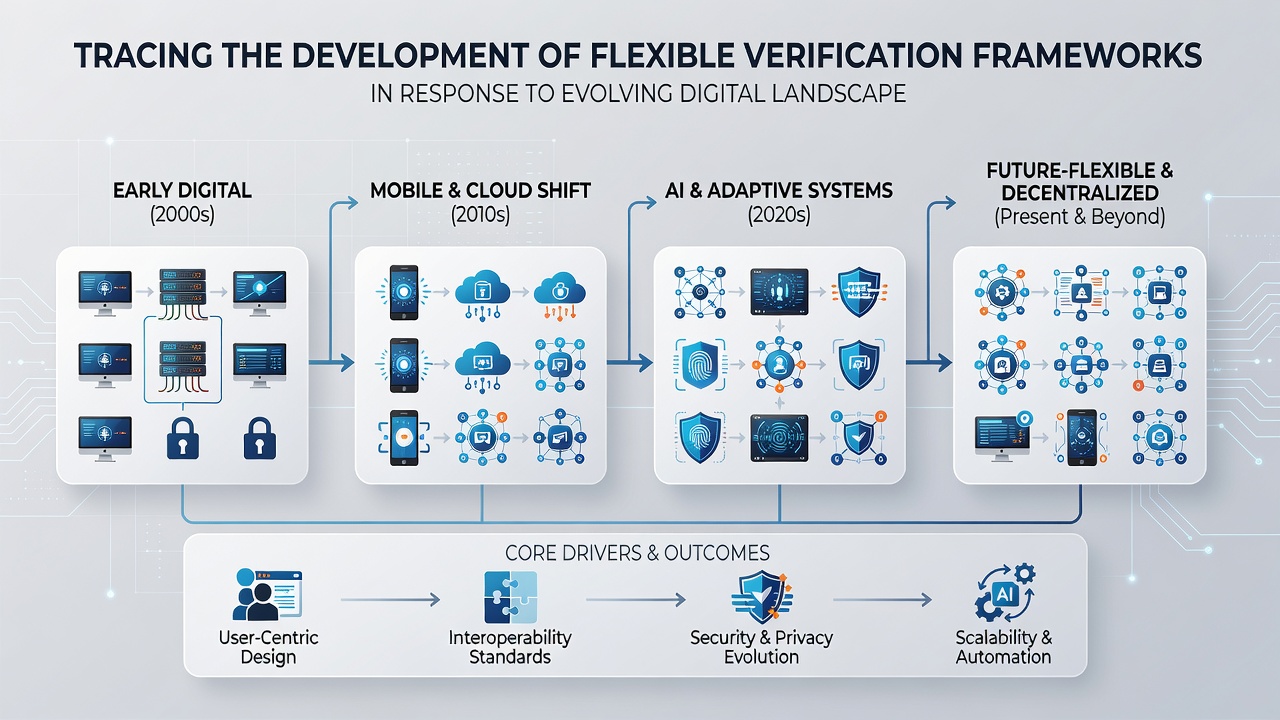
By September 2026 several standards bodies plan to release updated guidance on continuous authentication, and early drafts suggest emphasis on privacy-preserving techniques such as federated learning that keep raw behavioral data on user devices. This direction aligns with ongoing work at research institutions exploring zero-knowledge proofs for identity claims, allowing verification without exposing underlying attributes.
Case Examples from Different Sectors
Healthcare providers adopted flexible verification to comply with patient data access rules, and one hospital network integrated device posture checks with electronic health record systems so that access rights adjusted based on network location and clinician role. Retail platforms followed a similar path, embedding behavioral biometrics that score mouse movements and typing cadence during checkout flows, and the resulting risk signals feed into payment authorization decisions without adding noticeable friction for legitimate users.
Government digital services in multiple countries have piloted reusable identity components that citizens can link across agencies, and these pilots rely on modular verification that swaps in stronger methods when higher assurance levels are required for benefits claims or tax filings. The approach avoids duplicating enrollment processes while still meeting sector-specific audit requirements.
Conclusion
Verification frameworks continue to evolve through incremental additions of contextual signals, machine learning components, and regulatory alignment points, and the pattern shows organizations prioritizing architectures that accept new inputs without disrupting existing user flows. Data collected across industries reveals measurable reductions in account takeover incidents once adaptive layers replaced rigid checks, while privacy regulations simultaneously drive the adoption of techniques that limit data exposure. The trajectory points toward systems that treat verification as an ongoing process rather than a single gate, and this shift matches the distributed nature of current digital interactions.